

Appearance
UCalgary Space Remote Sensing
Open Science Platform
Facilitating collaborative research, data sharing, and knowledge dissemination by making scientific resources freely accessible to the public.
117
Operational Sensors
Canada, US, Greenland, Antarctica
23
Instrument Array Datasets
1.1 PB+
Data Archive Volume
50K+
Real-Time Data Streams
2K+
Scientific Users
Last 12 months
122K+
Public Users
Last 12 months
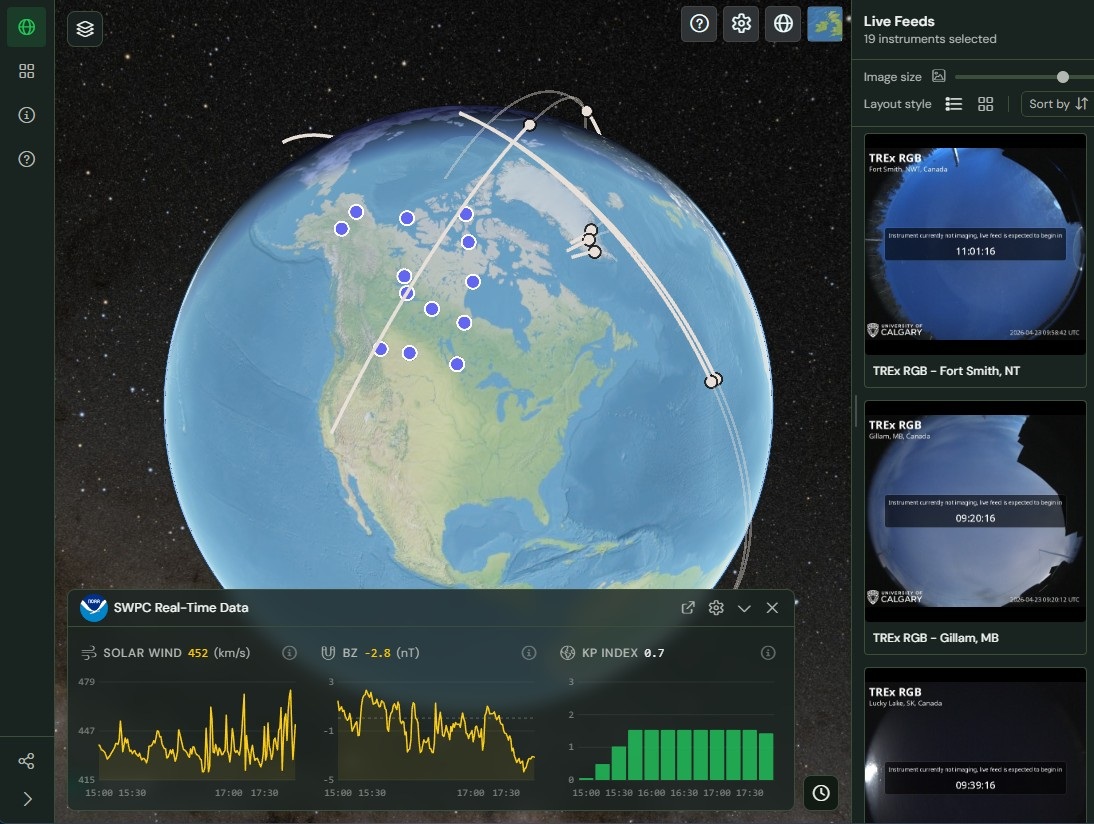
Real-Time Data Streams
Watch data flow in from instruments across the globe, live.
Live Data Streams
Connecting...
Platform at a Glance
Publications per Year
- Introduction to TREx-ATM V2.0: A Versatile Model of Auroral Transport and Its Effects in the Ionosphere
- Nitric Oxide Intensification Associated With STEVE: TIMED/SABER-REGO Observations and Comparison With GITM Simulation
- F-Region Neutral Wind Response to Multiscale Geomagnetic Forcing During the 27 March 2014 Substorm Event
Latest Bulletins
June 12, 2026Jun 12AuroraX dark mode
The AuroraX website now has a full dark-mode implementation. Users can toggle between light and dark themes across all pages and tools.
June 5, 2026Jun 5SMILE ASI deployed to Mt Washington Observatory, New Hampshire, USA
A SMILE All-Sky Imager (ASI) has been deployed to the Mt Washington Observatory in New Hampshire, and is now operational. This deployment was a joint effort between UCalgary and Amy Keesee at the University of New Hamsphire. Skymaps are available for this site.
Due to the extreme weather conditions at this site, we are hopeful that we can run through the winter and collect high quality data. Time will tell!
June 3, 2026Jun 3SMILE ASI deployed to Kapuskasing, ON
A SMILE All-Sky Imager (ASI) has been deployed to Kapuskasing, Ontario and is now operational. Skymaps are available for this site.
May 5, 2026May 5AuroraX website revamp
April 24, 2026Apr 24Homepage updates
Several updates to the website: a redesigned homepage with news front and center and an interactive real-time data globe showing live data from our instruments.
Latest News
0:00 / 0:00
Our Data
Browse our open data archive. The archive is accessible using a variety of methods, including HTTP, FTP, Rsync, Python libraries, IDL library, and direct API-based access.
- HTTP:by project, by instrument type
- Rsync:
rsync rsync://data.phys.ucalgary.ca - FTP:
ftp://data.phys.ucalgary.ca - API:api.phys.ucalgary.ca
- View thestatus of the platform
- Explore thearchive data volume
- Explore thedataset documentation
0:00 / 0:00
Working with our Data
We provide several libraries for working with our data, along with a vast example gallery. Tools are for Python and IDL, along with a RESTful API available for direct interaction.
- Explore oursoftware packages
- Learn how todownload data
- Explore the crib sheets:Python, IDL
- New to our data? Follow ourlearning pathsto get started
- Writing a paper? Learnhow to citeuse of our datasets and tools
- Learn about theAPI
Data Discovery & Visualizations
Explore our data through a variety of websites and visualizations developed to support exploration and discovery of our data.
Learn MoreFrequently Asked Questions
How do I properly acknowledge and cite the data I'm using?
Each dataset contains an acknowledgements file housed in the appropriate data tree. The file contains required data acknowledgements and/or the DOI for the dataset (e.g., REGO). You can also consult the list of datasets to find links to appropriate acknowledgements file. If you cannot find what you are looking for, please reach out.
I think something is wrong, who do I contact about the data I'm using?
If you encounter issues or have questions about the data please reach out to the instrument contact listed on the Dataset Documentation page.
Can you change the operating mode of the sensors to support my science?
Some UCalgary instrumentation has capacity for different operating modes. If you are interested in discussing operational modes, please reach out to the contact for the appropriate instrument type/network.
Are there any new sensors planned for the near future?
We are always looking for ways to improve the quality and information content of our data. This can be modifications to operational modes, calibration procedures, or designing next generation instrumentation. Currently, SMILE-ASI is in active development, with GDC-G following closely behind. If you are interested in learning more, please reach out the UCalgary team.
How do I get last night's full resolution data?
Depending on the instrument type, full resolution data may not be available in real-time. Higher data rate systems (e.g., ASIs) often rely on physical recovery of hard drives with a 3-6 month lag for data to be available. Our data archive is built on a philosophy of 'if we have it, you have it', so for our fully operational systems if you do not see full resolution data, it is very likely still in the field. For high-value data, and on request, we can sometimes retrieve portions of large datasets (e.g., an hour of data). If you have a specific data request please reach out to the instrument contact.
Have Questions?
If you have any questions, please don't hesitate to contact us.