

Appearance
UCalgary Space Remote Sensing
Open Science Platform
Facilitating collaborative research, data sharing, and knowledge dissemination by making scientific resources freely accessible to the public.
130
Operational Sensors
Canada, US, Greenland, Antarctica
23
Instrument Array Datasets
1.2 PB+
Data Archive Volume
50K+
Real-Time Data Streams
2K+
Scientific Users
Last 12 months
122K+
Public Users
Last 12 months
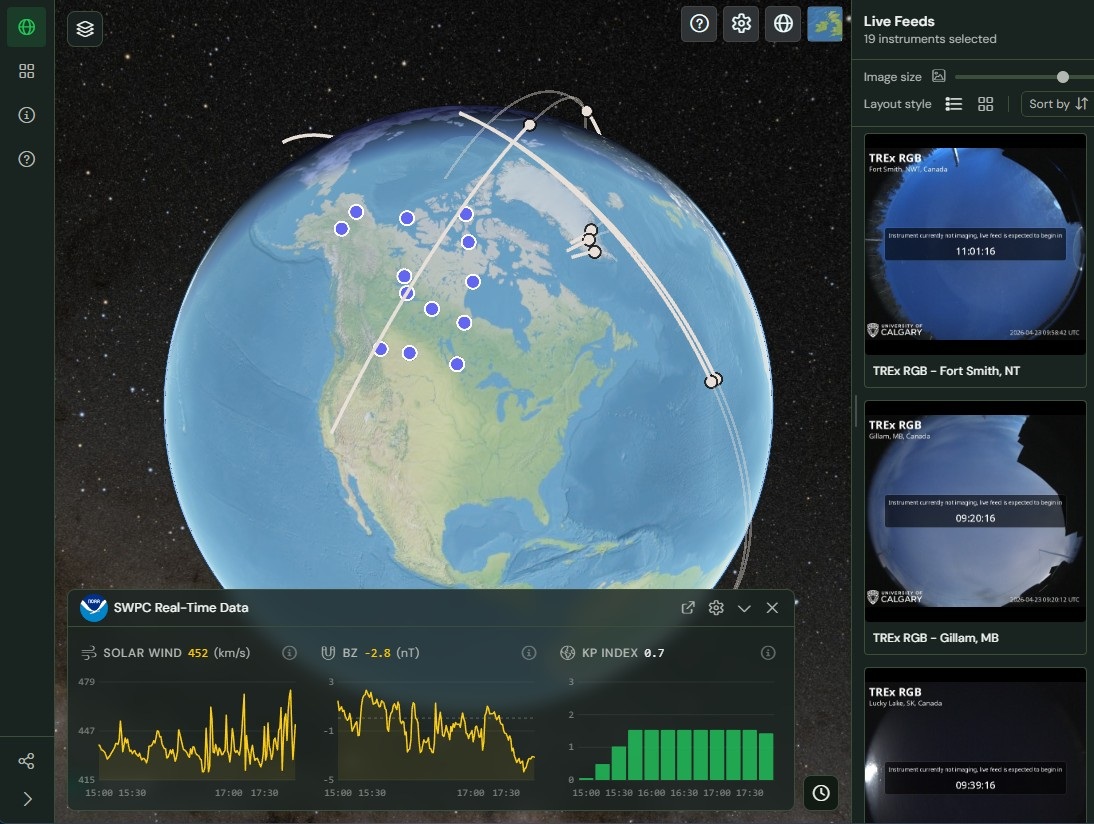
Real-Time Data Streams
Watch data flow in from instruments across the globe, live. Learn more
Live Data Streams
Connecting...
Platform at a Glance
Latest Bulletins
October 14, 2026Oct 14Software releases: PyAuroraX v1.27.0, IDL-AuroraX v1.12.0
PyAuroraX v1.27.0
- added
aurorax.tools.geocentric_to_geodetic()to support converting geocentric spacecraft locations and footprints to geodetic - updated
LocationandEphemerisDatadocstrings to state- spacecraft ephemeris location values are geocentric, retrieved from SSCWeb
nbtrace/sbtraceare the field-line footprints traced to 100 kmlocation_geois the sub-satellite point
- updated crib sheets that plot satellite footprints
plot_satellite_footprint_on_ccd_imageandmosaic_with_satellite_location_datanow plot thenbtracefootprint converted to geodetic instead of thelocation_geosub-satellite point- note that these updates change the plotted location of spacecraft by ~20km
IDL-AuroraX v1.12.0
- added
aurorax_geocentric_to_geodetic()to support converting geocentric spacecraft locations and footprints to geodetic - updated
aurorax_ephemeris_search()docstrings to state- spacecraft ephemeris location values are geocentric, retrieved from SSCWeb
nbtrace/sbtraceare the field-line footprints traced to 100 kmlocation_geois the sub-satellite point
- updated crib sheets that plot satellite footprints
aurorax_example_movie_satellite_footprint_trex_rgb,aurorax_example_ephemeris_oplot_mosaic, andaurorax_example_ephemeris_multi_oplot_mosaicnow plot thenbtracefootprint converted to geodetic instead of thelocation_geosub-satellite point- note that these updates change the plotted location of spacecraft by ~20km
September 29, 2026Sep 29TREx RGB operating mode metadata filter
TREx RGB ephemeris records in AuroraX now include an operating_mode metadata field, which records how each imager was operating for every minute of data. The imagers normally take an image every 3 seconds (3s-nominal), and for selected periods they also save higher-cadence 3Hz "burst" data (3hz-burst). Using this field as a metadata filter in a conjunction search or an ephemeris search, you can now find exactly the times when TREx RGB burst data is available.
The operating mode is only known once the raw data from a site has been ingested into the UCalgary archive, so this field typically lags a few months behind real-time. It is tied to the existing raw_data_exists field: records from before the raw data is ingested will not have an operating mode yet, and gain one once raw_data_exists becomes true. See Searching for Conjunctions for how to use metadata filters.
September 28, 2026Sep 28NOAA-21 satellite added to Swarm-Aurora and AuroraX
September 25, 2026Sep 25AuroraX news section added
September 25, 2026Sep 25SMILE spacecraft added to Swarm-Aurora and AuroraX, plus Conjunction Finder updates
With the recently-launched SMILE (Solar wind Magnetosphere Ionosphere Link Explorer) spacecraft now out of commissioning, we have added it to Swarm-Aurora and AuroraX. You can now search and explore conjunctions with SMILE, and enable it in the real-time viewer. Please note that the SMILE spacecraft is separate from the SMILE ASI network, which remains available as a ground-based instrument (added January 2026).
The Swarm-Aurora Conjunction Finder has also received a few improvements:
- A new Hemisphere setting, found below the HEO satellites list, controls which parts of the satellite traces are displayed. Choose North, South, Both, or Auto (the default, which follows the map you are viewing). When loading conjunction search results from AuroraX, Auto chooses the hemisphere for each conjunction based on where the LEO spacecraft were at the time, so conjugate conjunctions are displayed correctly.
- Keograms can now be quickly closed. Hover over a keogram and click the X in the top right corner to remove it and deselect the corresponding field of view on the map.
Latest News
0:00 / 0:00
Our Data
Browse our open data archive. The archive is accessible using a variety of methods, including HTTP, FTP, Rsync, Python libraries, IDL library, and direct API-based access.
- HTTP:by project, by instrument type
- Rsync:
rsync rsync://data.phys.ucalgary.ca - FTP:
ftp://data.phys.ucalgary.ca - API:api.phys.ucalgary.ca
- View thestatus of the platform
- Explore thearchive data volume
- Explore thedataset documentation
0:00 / 0:00
Working with our Data
We provide several libraries for working with our data, along with a vast example gallery. Tools are for Python and IDL, along with a RESTful API available for direct interaction.
- Explore oursoftware packages
- Learn how todownload data
- Explore the crib sheets:Python, IDL
- New to our data? Follow ourlearning pathsto get started
- Writing a paper? Learnhow to citeuse of our datasets and tools
- Learn about theAPI
Data Discovery & Visualizations
Explore our data through a variety of websites and visualizations developed to support exploration and discovery of our data.
Learn MoreFrequently Asked Questions
How do I properly acknowledge and cite the data I'm using?
Each dataset contains an acknowledgements file housed in the appropriate data tree. The file contains required data acknowledgements and/or the DOI for the dataset (e.g., REGO). You can also consult the list of datasets to find links to appropriate acknowledgements file. If you cannot find what you are looking for, please reach out.
I think something is wrong, who do I contact about the data I'm using?
If you encounter issues or have questions about the data please reach out to the instrument contact listed on the Dataset Documentation page.
Can you change the operating mode of the sensors to support my science?
Some UCalgary instrumentation has capacity for different operating modes. If you are interested in discussing operational modes, please reach out to the contact for the appropriate instrument type/network.
Are there any new sensors planned for the near future?
We are always looking for ways to improve the quality and information content of our data. This can be modifications to operational modes, calibration procedures, or designing next generation instrumentation. Currently, SMILE-ASI is in active development, with GDC-G following closely behind. If you are interested in learning more, please reach out the UCalgary team.
How do I get last night's full resolution data?
Depending on the instrument type, full resolution data may not be available in real-time. Higher data rate systems (e.g., ASIs) often rely on physical recovery of hard drives with a 3-6 month lag for data to be available. Our data archive is built on a philosophy of 'if we have it, you have it', so for our fully operational systems if you do not see full resolution data, it is very likely still in the field. For high-value data, and on request, we can sometimes retrieve portions of large datasets (e.g., an hour of data). If you have a specific data request please reach out to the instrument contact.
Have Questions?
If you have any questions, please don't hesitate to contact us.