

Appearance
UCalgary Space Remote Sensing
Open Science Platform
Facilitating collaborative research, data sharing, and knowledge dissemination by making scientific resources freely accessible to the public.
118
Operational Sensors
Canada, US, Greenland, Antarctica
23
Instrument Array Datasets
1.2 PB+
Data Archive Volume
50K+
Real-Time Data Streams
2K+
Scientific Users
Last 12 months
122K+
Public Users
Last 12 months
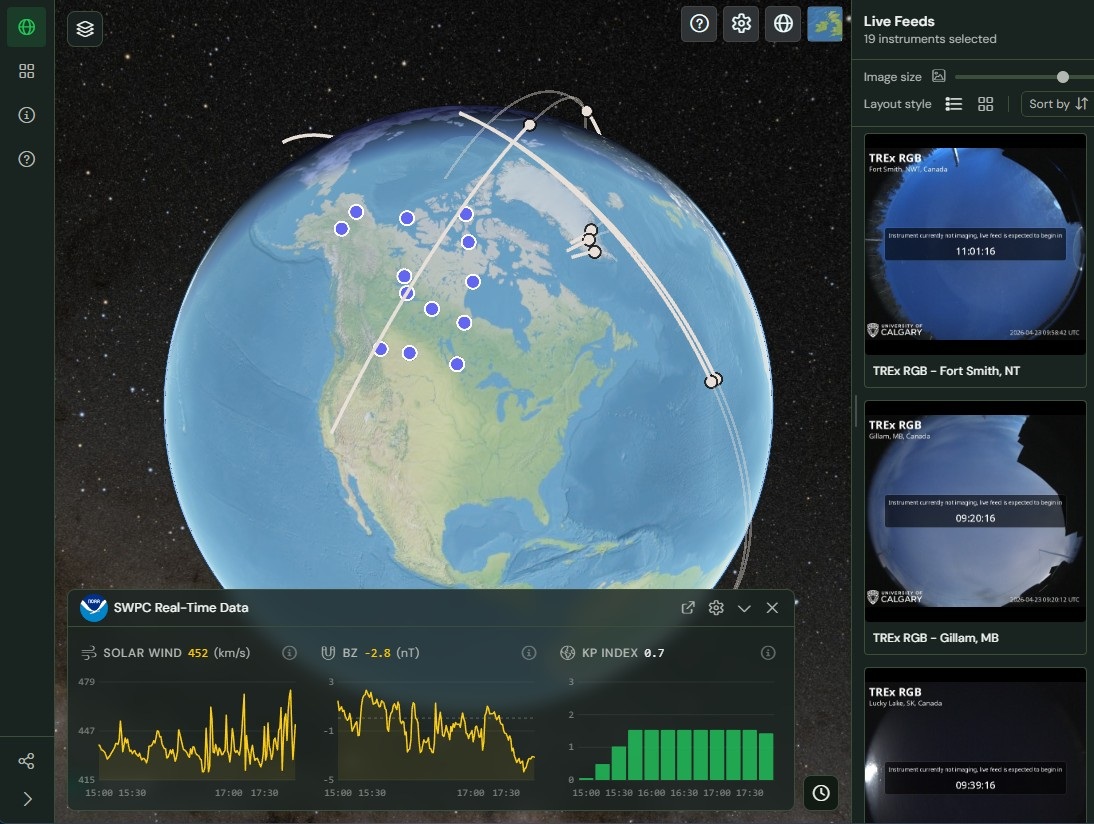
Real-Time Data Streams
Watch data flow in from instruments across the globe, live. Learn more
Live Data Streams
Connecting...
Platform at a Glance
Publications per Year
- Introduction to TREx-ATM V2.0: A Versatile Model of Auroral Transport and Its Effects in the Ionosphere
- Nitric Oxide Intensification Associated With STEVE: TIMED/SABER-REGO Observations and Comparison With GITM Simulation
- F-Region Neutral Wind Response to Multiscale Geomagnetic Forcing During the 27 March 2014 Substorm Event
Latest Bulletins
September 15, 2026Sep 15AuroraX API improvements
We have deployed an update to the AuroraX API which includes several bugfixes and operational improvements to the AuroraX API, aimed at improving the reliability, maintainability, and security of the service. No changes are required for existing users.
September 9, 2026Sep 9AuroraX sub-minute conjunction searching
AuroraX Conjunction Search now supports sub-minute conjunctions. Searches have previously been limited to one-minute precision, meaning conjunctions occurring on shorter timescales could be missed. Sub-minute precision is opt-in, so existing searches are unaffected.
Programmatic access is available in PyAuroraX v1.24.0 and IDL-AuroraX v1.10.0 and later. Examples of usage can be found in the conjunction searching crib sheets for Python and IDL.
September 9, 2026Sep 9Software releases: PyAuroraX v1.24.0, IDL-AuroraX v1.10.0, IDL-AuroraX v1.10.1
PyAuroraX v1.24.0
- added
subminute_precisionparameter to conjunction searching, enabling conjunctions at sub-minute precision instead of the default one-minute precision- added the parameter to the
aurorax.search.conjunctions.search()function and theConjunctionSearchclass - added the field to the CLI conjunction search template
- added backwards compatibility for the deprecated
epoch_search_precisionfield
- added the parameter to the
- updated conjunction searching examples notebook, including a new example of searching with sub-minute precision
- test suite updates
IDL-AuroraX v1.10.0
- added support for sub-minute precision conjunction searching (
/subminute_precisionkeyword) - updated conjunction searching crib sheet
IDL-AuroraX v1.10.1
- added a test suite, see
tests/README.mdfor how to run it - bugfixes
- metadata filters created with
/operator_orwere silently built with 'AND' instead - calibrating a single image raised an error instead of working
- dark frame calibration wrongly zeroed the last pixel of any image stack with no negative pixels
- supplying
data_product_typesto a data products search raised an error - search durations of an hour or longer were reported without the hours (an hour showed as '0 minutes')
- February was treated as having 28 days in leap years outside 1980-2040
- several functions raised an error on invalid input rather than returning cleanly: an out-of-range criteria block count, a conjunction search with fewer than two criteria blocks, and a conjunction search given a distance that is neither a number nor a pairings hash
aurorax_fov_oplotcould stall a non-interactive session when given mismatched numbers of site latitudes and longitudesaurorax_spectra_get_intensitycarried on after reporting an invalidspect_loc
- metadata filters created with
- corrected error messages that named the wrong function, and fixed typos in user-facing output
- added a
.gitattributesfile to keep line endings consistent
September 8, 2026Sep 8Software release: PyAuroraX v1.23.0
PyAuroraX v1.23.0
- added
--api-timeoutoption to the CLI for setting the API request timeout - multiprocessing in
tools.movie()andtools.mosaic.prep_skymaps()now uses theforkserverstart method where available, adopting the Python 3.14 default - test suite updates
August 22, 2026Aug 22SMILE ASI deployed to Kluane Lake Research Station, Yukon
A SMILE All-Sky Imager (ASI) has been deployed to UCalgary's Kluane Lake Research Station, Yukon and is now operational. A skymap has been generated and is available for use. The summary data is also available now to browse in Swarm-Aurora, AuroraX, and the Data Portal.
Latest News
0:00 / 0:00
Our Data
Browse our open data archive. The archive is accessible using a variety of methods, including HTTP, FTP, Rsync, Python libraries, IDL library, and direct API-based access.
- HTTP:by project, by instrument type
- Rsync:
rsync rsync://data.phys.ucalgary.ca - FTP:
ftp://data.phys.ucalgary.ca - API:api.phys.ucalgary.ca
- View thestatus of the platform
- Explore thearchive data volume
- Explore thedataset documentation
0:00 / 0:00
Working with our Data
We provide several libraries for working with our data, along with a vast example gallery. Tools are for Python and IDL, along with a RESTful API available for direct interaction.
- Explore oursoftware packages
- Learn how todownload data
- Explore the crib sheets:Python, IDL
- New to our data? Follow ourlearning pathsto get started
- Writing a paper? Learnhow to citeuse of our datasets and tools
- Learn about theAPI
Data Discovery & Visualizations
Explore our data through a variety of websites and visualizations developed to support exploration and discovery of our data.
Learn MoreFrequently Asked Questions
How do I properly acknowledge and cite the data I'm using?
Each dataset contains an acknowledgements file housed in the appropriate data tree. The file contains required data acknowledgements and/or the DOI for the dataset (e.g., REGO). You can also consult the list of datasets to find links to appropriate acknowledgements file. If you cannot find what you are looking for, please reach out.
I think something is wrong, who do I contact about the data I'm using?
If you encounter issues or have questions about the data please reach out to the instrument contact listed on the Dataset Documentation page.
Can you change the operating mode of the sensors to support my science?
Some UCalgary instrumentation has capacity for different operating modes. If you are interested in discussing operational modes, please reach out to the contact for the appropriate instrument type/network.
Are there any new sensors planned for the near future?
We are always looking for ways to improve the quality and information content of our data. This can be modifications to operational modes, calibration procedures, or designing next generation instrumentation. Currently, SMILE-ASI is in active development, with GDC-G following closely behind. If you are interested in learning more, please reach out the UCalgary team.
How do I get last night's full resolution data?
Depending on the instrument type, full resolution data may not be available in real-time. Higher data rate systems (e.g., ASIs) often rely on physical recovery of hard drives with a 3-6 month lag for data to be available. Our data archive is built on a philosophy of 'if we have it, you have it', so for our fully operational systems if you do not see full resolution data, it is very likely still in the field. For high-value data, and on request, we can sometimes retrieve portions of large datasets (e.g., an hour of data). If you have a specific data request please reach out to the instrument contact.
Have Questions?
If you have any questions, please don't hesitate to contact us.